BOXTOP ELECTROMECHANICAL EQUIPMENT
Linear Motion Systems are becoming essential to modern production, packaging, laboratory automation, and warehouse equipment. They guide, position, and move loads with controlled accuracy. A small rail may support a robotic gripper, while a larger actuator can move a machining platform weighing several tonnes.
Industry data confirms this growing demand. The International Federation of Robotics reported 541,302 industrial robots installed worldwide in 2023. Many of these systems depend on linear guides, ball screws, actuators, or motorized stages. MarketsandMarkets has also identified automation, semiconductor production, and advanced manufacturing as major forces supporting linear motion market growth. Its research projects continued expansion through 2028, although market estimates vary by product definition and region.
This guide reviews the Top 10 Linear Motion Systems Suppliers Worldwide through practical criteria. These include product breadth, positioning accuracy, load capacity, customization, global service, delivery capability, and documented quality practices. Public company information, technical catalogs, industry research, and application evidence provide the foundation for comparison. Supplier reputation alone is not enough.
Real performance depends on installation, lubrication, alignment, duty cycle, and operating environment. A premium actuator can still fail when maintenance is neglected. That detail is easy to overlook. Rankings should therefore support engineering decisions, not replace them. Some market reports also combine components with complete systems, creating imperfect comparisons. This article recognizes that limitation and focuses on suppliers with strong technical depth, international reach, and credible manufacturing experience.
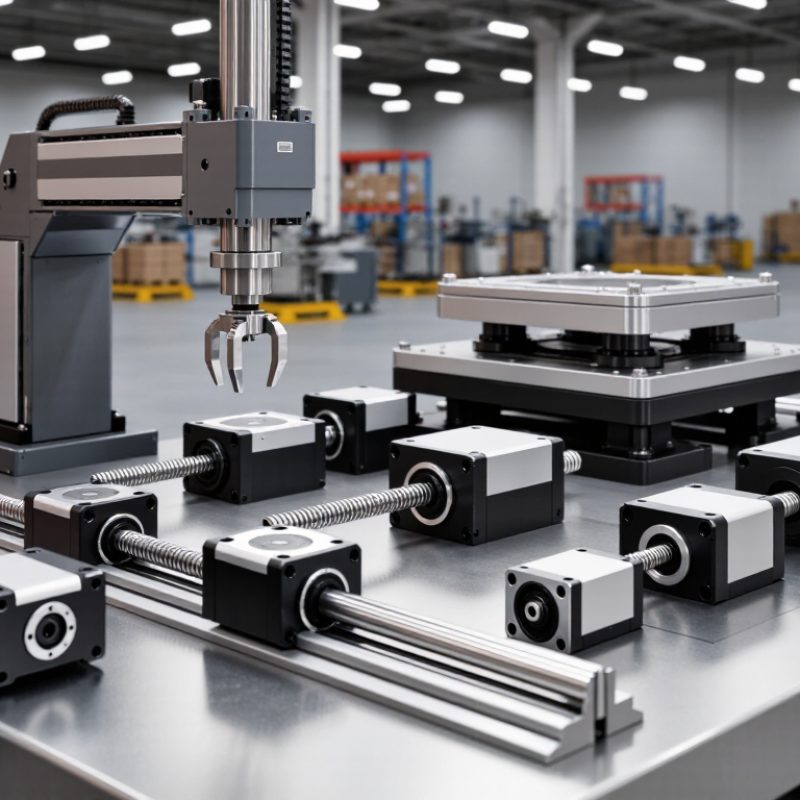
Top 10 Linear Motion Systems Suppliers Worldwide
Definition and Core Components of Linear Motion Systems
A linear motion system moves a load along a straight path with controlled speed and positioning. In a packaging machine, for example, it may slide a gripper between two stations, repeating the same short movement thousands of times. The system is more than a rail. It combines guidance, drive, support, and control components to manage motion and resist loads.
Its guide rail and carriage constrain movement and carry side loads. A ball screw, belt, rack, or linear motor supplies the driving force. A motor and controller regulate speed and acceleration, while an encoder or other feedback device reports position. The frame, bearings, seals, and lubrication also matter. They influence stiffness, friction, noise, and service life. Not just rails. I would not call any one layout “best”; that shortcut can hide trade-offs in stroke length, precision, payload, and maintenance access.
The International Federation of Robotics reported 541,302 industrial robots installed worldwide in 2023 in its World Robotics 2024 report. That figure describes robot installations, not linear-system sales, but it illustrates the automation environment in which accurate guided motion is used. For engineers, component selection should start with the actual load, travel, duty cycle, and accuracy requirement—not a catalogue headline. A small mismatch in alignment or lubrication can become noticeable as heat, vibration, or uneven wear. That detail is easy to underestimate.
Linear motion systems convert rotary or electromagnetic force into controlled straight-line movement. A motor drives a ball screw, belt, rack, or linear motor. Guides then manage alignment and reduce unwanted friction. Feedback devices measure position and speed. The controller adjusts movement within milliseconds.
In packaging lines, axes place products with repeatable timing. In machining, they move cutting tools across rigid frames. Warehouse equipment uses them for lifting, sorting, and transfer operations.
According to the International Federation of Robotics’ World Robotics 2024 report, 541,302 industrial robots were installed worldwide in 2023. Many of these systems depend on coordinated linear axes.
The details matter. A dusty factory may require sealed guides and protected sensors. High-speed pick-and-place equipment needs low moving mass. Heavy machining requires stiffness more than acceleration. Grand View Research estimates the global linear motion systems market will expand at about 7% annually through 2030. However, market forecasts vary by definition and region. That uncertainty deserves attention.
Poor alignment remains a common failure source. Small installation errors can create heat, vibration, and premature wear. Lubrication intervals also change with load, speed, and contamination. Engineers should validate travel accuracy under real operating conditions, not only on a test bench. ISO 230 measurement practices can support this verification, although they cannot replace practical maintenance records.
Evaluating worldwide linear motion suppliers requires more than comparing catalog prices. In practice, engineers inspect load ratings, travel accuracy, repeatability, speed, and duty cycles. A supplier should explain how those figures were measured. Test conditions matter. A rail rated for a clean laboratory may perform differently near dust, vibration, or temperature changes. Ask for application data, not polished claims. Check whether the supplier can provide CAD files, tolerance charts, installation guidance, and maintenance intervals. Clear documentation signals technical maturity and saves design time.
Reliability appears in details that are easy to overlook. Review bearing life calculations, lubrication options, corrosion resistance, and replacement-part availability across regions. Confirm production capacity and realistic lead times, especially for custom assemblies. One delayed carriage can stop an entire machine. Speak with application engineers who can discuss misalignment, moment loads, and mounting errors without hiding uncertainty. Their response often reveals more than a sales brochure. Independent certifications, traceable inspection records, and documented quality controls strengthen confidence, but certificates alone prove little.
A useful evaluation also measures service after delivery. Ask about commissioning support, failure analysis, warranty boundaries, and response times in your operating region. Request references from applications with similar loads and environments. Site visits can expose practical habits, such as poor packaging or inconsistent labeling. I would not score every supplier with the same formula. That is a weakness. Medical equipment, warehouse automation, and outdoor machinery need different priorities. Build a weighted scorecard, record assumptions, and test shortlisted components under real operating conditions before committing to volume purchases.
Criteria for Evaluating Worldwide Linear Motion Suppliers
This weighted framework highlights the main procurement dimensions used when comparing global linear motion system suppliers. Product breadth, precision, load and speed capability, service coverage, certifications, integration support, and total cost of ownership should be assessed together rather than by price alone. The percentages represent an evaluation model and are not company performance scores.
Top 10 Linear Motion Systems Suppliers Worldwide
The worldwide linear motion systems market is expanding with factory automation, robotics, medical equipment, and semiconductor production. Fortune Business Insights estimated the market at about USD 10.1 billion in 2023, with continued growth projected through 2032. A meaningful Top 10 supplier list should examine more than revenue. Engineering depth matters.
The strongest suppliers typically provide guideways, ball screws, actuators, stages, and integrated control options. Their products must maintain smooth travel under changing loads. In a packaging plant, a carriage may repeat thousands of short movements each day. Micron-level accuracy can decide whether a wafer stage passes inspection. Buyers should compare load capacity, repeatability, sealing performance, service coverage, and delivery reliability. Product documentation is equally important.
Market reports from MarketsandMarkets identify automation investment as a major growth driver. However, rankings can become misleading when they rely only on company size. Data may lag behind factory reality. A smaller supplier may offer better customization or faster technical support in a specific region. That difference matters during commissioning. It can save weeks of downtime.
The Top 10 worldwide should therefore represent proven manufacturing capability, broad application knowledge, dependable quality systems, and measurable customer support. Independent testing, published tolerances, warranty terms, and field experience deserve careful review. No ranking is perfect. Availability can change quickly.
The linear motion systems market is shifting toward compact, energy-efficient, and connected equipment. Suppliers now combine guideways, actuators, drives, and control interfaces into easier-to-configure platforms. This reduces installation time on packaging, inspection, robotics, and medical production lines. Yet, higher integration can limit flexibility when a machine requires unusual travel lengths or loads.
End users should begin with the working conditions, not a catalog ranking. Measure payload, stroke, speed, acceleration, positioning accuracy, and duty cycle. A 500 mm stroke at moderate speed creates different demands from a 100 mm stroke with rapid indexing. Check dust, humidity, washdown exposure, and temperature changes. These details often determine whether a ball screw, belt drive, linear motor, or roller-based system is appropriate. Ask suppliers for test data, life calculations, maintenance intervals, and documented tolerance limits.
Total cost deserves careful attention. Purchase price is only one part of the decision. Lubrication, replacement components, energy use, downtime, and technician training may dominate long-term expenses. During supplier comparisons, request sample drawings and confirm mounting dimensions early. Small interface errors can delay commissioning for days. No checklist is perfect. Real operating data may challenge the original specification, especially when operators change speed settings after installation. A practical evaluation should include a pilot test, noise observations, thermal checks, and feedback from maintenance staff. This evidence is more reliable than attractive performance claims.
Note: The entries below are anonymized supplier profiles representing common capabilities in the global market. They are not company names, a verified supplier ranking, or market-share estimates. Product availability and performance vary by model and configuration.
| Profile | Primary System Focus | Typical Product Scope | Common End Uses | Relevant Market Trend | Key Selection Factors |
|---|---|---|---|---|---|
| Supplier Profile 01 | Precision linear guides and rolling-element motion components | Profile rails, carriages, linear bearings, and matched guide assemblies | Machine tools, semiconductor equipment, inspection systems, and factory automation | Demand for higher repeatability and compact guide arrangements in automated equipment | Load rating, stiffness, accuracy class, preload options, lubrication, and operating environment |
| Supplier Profile 02 | Ball-screw-driven linear positioning | Ball screws, support bearings, screw-driven actuators, and positioning modules | CNC machinery, assembly equipment, packaging lines, and precision positioning axes | Greater use of integrated screw-and-guide modules to simplify machine design and assembly | Required thrust, lead, travel, speed, positioning accuracy, duty cycle, and critical-speed limits |
| Supplier Profile 03 | Electric linear actuators and axis modules | Enclosed actuators, guided cylinders, single-axis units, and multi-axis configurations | Material handling, packaging, assembly, and applications replacing pneumatic motion | Electrification of motion for improved controllability, programmability, and process monitoring | Payload, stroke, speed, mounting orientation, ingress protection, and controller compatibility |
| Supplier Profile 04 | Direct-drive linear motors and precision stages | Iron-core and ironless motor axes, precision stages, and multi-axis platforms | Semiconductor and electronics manufacturing, metrology, and high-speed pick-and-place | Adoption of direct drive where high dynamic response and low mechanical backlash are priorities | Peak and continuous force, thermal management, feedback resolution, travel, and motion profile |
| Supplier Profile 05 | Compact linear guides and miniature positioning components | Miniature rails, small carriages, miniature screws, and compact stages | Medical instruments, laboratory automation, optical equipment, and small-format machinery | Equipment designs are becoming more compact while retaining repeatable positioning capability | Envelope size, allowable load, smoothness, cleanliness, corrosion resistance, and mounting accuracy |
| Supplier Profile 06 | Heavy-duty linear motion systems | Large guideways, high-capacity rollers, heavy-load slides, and protected axes | Metalworking, presses, large machine tools, and industrial handling systems | Users are prioritizing reliability and maintainability in demanding, high-load applications | Static and dynamic load capacity, shock loads, contamination protection, lubrication, and service access |
| Supplier Profile 07 | Cleanroom and low-particle motion solutions | Cleanroom-compatible guides, actuators, lubricants, covers, and sealed motion modules | Semiconductor fabrication, flat-panel production, pharmaceutical equipment, and laboratories | More motion systems are being specified for controlled environments with strict contamination limits | Cleanroom classification requirements, particle generation, outgassing, materials, and maintenance procedures |
| Supplier Profile 08 | Corrosion-resistant and washdown-compatible linear systems | Resistant guides, sealed actuators, protective covers, and application-specific assemblies | Food and beverage processing, outdoor machinery, marine equipment, and chemical environments | Greater attention to hygienic design, equipment washdown, and longer service life in harsh environments | Exposure to moisture or chemicals, sealing, material compatibility, cleaning method, and lubricant choice |
| Supplier Profile 09 | Modular automation and configurable motion platforms | Standardized axes, connection hardware, multi-axis gantries, and application-ready modules | Robotics, intralogistics, packaging, and configurable production equipment | Modular designs help shorten integration time and support flexible production layouts | Available configurations, system integration effort, payload, axis synchronization, lead time, and support |
| Supplier Profile 10 | Connected motion systems and lifecycle support | Motion components paired with condition-monitoring options, configuration tools, and service programs | Continuous-process equipment, automated production lines, and maintenance-sensitive installations | Digital monitoring and predictive-maintenance practices are gaining attention across industrial automation | Sensor availability, data compatibility, maintenance access, spare-parts availability, and total lifecycle cost |
Compare load capacity, travel accuracy, repeatability, speed, and duty cycle. Ask how each figure was measured. Test conditions matter.
Dust, vibration, humidity, and temperature changes can alter performance. A clean laboratory result may not match a factory floor. That gap matters.
Request CAD files, tolerance charts, mounting dimensions, and installation guidance. Also ask for maintenance intervals and documented test data. Missing documents can slow design work.
Review bearing-life calculations, lubrication options, corrosion resistance, and replacement-part availability. Confirm realistic lead times and production capacity. One delayed carriage can stop a machine.
Ask about misalignment, moment loads, mounting errors, and unusual operating conditions. Good engineers explain uncertainty clearly. Perfect confidence can be suspicious.
Include purchase price, lubrication, energy use, spare parts, downtime, and technician training. A cheaper system may cost more after installation. This is easy to miss.
Measure payload, stroke, speed, acceleration, accuracy, and duty cycle. Dust and washdown exposure also matter. Different applications may require different drive methods.
A pilot test can reveal noise, heat, installation problems, and unexpected maintenance needs. Use real operating conditions. Original specifications may change after operators adjust speeds.
Build a weighted scorecard using application priorities, service, documentation, quality, and delivery. Do not use one formula for every machine. That approach is imperfect.
Ask about commissioning support, failure analysis, warranty limits, and regional response times. Request references from similar environments. Packaging and labeling deserve attention too.
Linear Motion Systems are essential technologies that enable controlled, precise, and repeatable movement in industrial equipment. This article explains their core components, including guides, rails, carriages, drive mechanisms, bearings, and control elements, and describes how these parts work together to support positioning, transport, assembly, machining, packaging, and automated inspection. By understanding operating principles such as friction reduction, load management, speed control, and motion accuracy, users can better match system designs to specific production requirements.
The article also presents a practical framework for evaluating worldwide suppliers without focusing on individual brands. Key considerations include product quality, engineering capability, customization options, reliability, technical support, delivery performance, maintenance needs, and total ownership cost. It further reviews major market trends, such as smarter automation, improved energy efficiency, compact designs, predictive maintenance, and increasing demand for flexible manufacturing. These insights help end users compare available solutions and select Linear Motion Systems that provide dependable performance, long service life, and strong value across different industrial applications.
